CLARKSVILLE, Mo. — What may be the only world championship decided in Pike County happened almost 140 years ago.
Sponsored by St. Louis-based American Wheelmen magazine, the exciting event was held in Clarksville on May 23, 1887.
Participants had to circle the 20-mile course five times on what was called The Belt Road – a mix of compacted stone, loose gravel and dirt pathways that meandered through the countryside.
“The course featured steep hills, challenging climbs, long straightaways and enough rough areas to make for a challenging competition,” wrote Kimberly Harper of the State Historical Society of Missouri.
Clarksville was a booming town in the 1880s, with almost 1,500 residents. Its eight factories included one of the only paper mills in Missouri. And it shared the national fascination with bicycles.
One of the first to gain attention was the “velocipede,” a now-archaic contraption with wooden wheels and iron tires that trembled so much when ridden that it was nicknamed “bone shaker.” After an 1869 exhibition in Clarksville, the editor of the Sentinel newspaper wrote that many wanted to ride one, but couldn’t handle the vibrations.
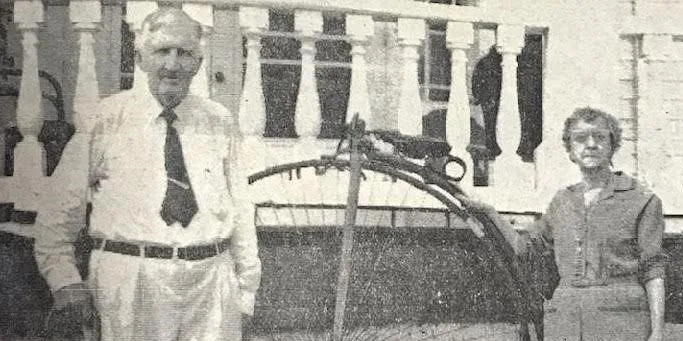
At least the velocipede had two equally-sized wheels. The “ordinary” had a huge one on the front and a tiny one on the back.
“They were difficult to mount, and once a rider began peddling, it was hard to bring the bicycle to a stop,” Harper wrote.
During one race, famous cyclist Stillman Whittaker had a problem with his ordinary and shouted for advice on how to halt without hurting himself. Mischievous fellow competitors told him to run into a tree, but Whittaker decided the safer alternative was a blackberry bush.
Riders summed up the danger by calling ordinaries “man slicers” for what sometimes happened when accidents took place. Despite flaws, the ordinary quickly became popular and would be the rig ridden at the Clarksville race.
The 10,000-member League of American Wheelmen held its 1887 national meeting in St. Louis, and chose Clarksville for the contest because it had the best course “for miles around,” wrote author Buck Peacock. The Missouri Historical Review called it the “best graveled road in the Middle West.” The Wheelmen would later describe Pike County as a “cyclers’ paradise.”
Clarksville had hosted a 50-mile competition in 1886 that drew widespread coverage, so the decision was no surprise. There were a few naysayers, of course.
St. Louis Post-Dispatch editor W.E. Hicks wasn’t impressed, saying one stretch was “a succession of mud holes.” The Chicago-based sponsor of one participant said it was “an outrage to ask a man to race over such a course.”
Nonetheless, competitors began arriving in Clarksville to finish training. The steamer Hudson docked with Wheelmen representatives and dozens of fans at 12:30 p.m. on Sunday, May 22.
“All Clarksville was out to greet them and Clarksville girls flocked on board the Hudson, where they sang a few songs and played the piano,” the Historical Review noted. “Many of the men tried out their wheels on the Pike County roads.”
Residents dressed in their best and “stood with smiling faces and buttonhole bouquets to welcome any passing wheelmen who might stop to cool his parched tongue with a dipper of well water or a glass of milk,” the publication said.
One Sunday night church service was packed with cycling enthusiasts “singing the hymns so lustily that it was said the organist had to use the loud pedal constantly in order to be heard,” the Review observed.
More singing took place later that night aboard Hudson, and additional spectators arrived by train and steamer. Rain fell overnight and a heavy mist the next morning caused the race to be delayed for an hour.
In addition to Whittaker, professional cyclists Robert Neilson, William Rhodes, H.G. Crocker, John Brooks and Charles Frazier were among those set to compete. Whittaker, the favorite, told the Louisiana Journal he felt like “a greased eel.”
“The contestants were a veritable Who’s Who of early American cycling,” author Sean McLachlan wrote in “It Happened in Missouri.”
Off they go
An estimated three thousand people lined the road near the starting line two miles south of Clarksville.
At 9:17 a.m., the moment all had been waiting for arrived.
“At the crack of a pistol, every pusher gave his man a tremendous shove and off they went,” the Journal reported.
Of the 10 men who had signed up, only six would complete the challenging course that extended to Calumet, Aberdeen and Turpin before returning to Clarksville.
The Journal called it a “terrible trial of power and resolution.” All but one racer rode an ordinary. After two laps, Neilson, Crocker and Rhodes jostled for the lead.
“They all seemed in good trim, and were within a few feet of one another,” the Journal reported.
Neilson and Rhodes had taken the brakes off their machines, and the Post-Dispatch noted they “rode down the hills like demons.” Whittaker and Samuel Hollingsworth were close behind. By the third lap, however, strain began to take its toll.
“Neilson had disfigured his face, but had, in some way or other, picked himself up and caught his companions,” the Journal said. Rhodes had fainted, but “after the administration of stimulants, he revived.” The perk-ups were not identified.
Frazier, who competed despite a severe left leg injury after a practice run crash along one of Clarksville’s hills, dropped out. Alfred McCurdy hit a rock and fell. He tried to resume, but could not. Brooks and Charles Ashinger also called it quits.
Neilson and Rhodes were the frontrunners as the fourth lap was completed. Crocker was two minutes behind and, after gulping two cups of water handed to him by a trainer, whizzed along “somewhat inspired by the urgent appeals of his friends to press on,” the Journal said.
Moments later, Crocker got more than a drink. A Clarksville man had been told to shower the cyclist with water. Unfortunately, the farmer let go of the bucket. The impact knocked Crocker off his bike, but he managed to get back on and continue.
The finish line had been set up just north of town across from the paper mill. Since the cyclists only made a lap a little more than once an hour, spectators had filled the time between by having picnics, listening to bands or socializing. Now, with the time nearing for racers to come in sight for the last push, they became anxious.
“The crowd was in a fever of excitement, and not altogether in the best humor,” the Journal noticed.
Neilson and Rhodes soon were spotted.
“The road was hard and smooth as a floor from this point to the finish, with a slight down grade near the tape, and Neilson, with his powerful track spurt, pressed closer to Rhodes, who was struggling to maintain the lead,” wrote Dorothy J. Caldwell in the Historical Review.
Neilson passed Rhodes to win the race with a time of six hours, 46 minutes and 27 seconds. Rhodes crossed 24 seconds later. Crocker came in third just five minutes behind. Hollingsworth outlasted Whittaker by only six seconds.
Caldwell called it “a thrilling ending.” The 10th competitor, Louis de Franklin Munger, had ridden a tricycle that featured two medium-sized wheels on the back and a smaller one up front. Though he couldn’t keep up with the others, Munger did break the 100-mile record for a three-wheeler at 10 hours and 42 minutes.
By the time Munger got back to Clarksville, Neilson had already hoisted the solid silver world championship cup valued at what would today be around $9,000. Other prizes also were awarded.
In a show of neighborliness that would extend to modern flood fighting, Clarksville residents and businesses contributed the 2026 equivalent of more than $28,000 to feed, house and entertain the cycling entourage.
More racing
With the invention of chain drives, sprocket gears, pneumatic tires and lighter materials, the ordinary would soon become obsolete.
But bicycling would remain a fixture around Clarksville.
Amateur racing continued in Missouri at the local level. In the northeast part of the state, Hannibal, Macon, Moberly and Shelbina boasted bicycle tracks, and The Belt Road remained a favorite day trip.
The 75th anniversary of the Clarksville race was observed in 1962, with the national championship ride of a little more than 62 miles. The winner was 26-year-old Bob Tetslaff, a fifth-grade teacher from San Jose, Calif.
“Twenty-seven riders (of 83 who entered) finished the race,” The Quincy Herald-Whig said. “Pile-ups, broken pedals, flat tires and broken wheels knocked the others out of the competition at various points.”
The June 24 event was part of the larger Clarksville River Festival, which featured helicopter rides, the Possum Holler Opry, a water show and dedication of the new skylift tourist attraction. One estimate put the crowd at 15,000.
Subsequent races were held throughout the 1960s, with the last big contest coming on the 100th anniversary in 1987. Showing that some things rarely change, only 11 of the 60 competitors finished.
To this day, motorists can find a designated bicycle lane along Highway 79 between Clarksville and Louisiana.
CUTLINE FOR PHOTO:
Harry Clifford Carroll and Dora Boone Clifford stand beside a high-wheeler in advance of the 1962 national bicycle race in Clarksville. Both recalled the 1887 world championship held there. (Louisiana Press-Journal photo)