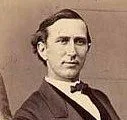
Brent Engel, contributing writer.
David Patterson Dyer was surprised when chosen to seek convictions in the 1875 Whiskey Ring fraud.
The Louisiana lawyer was not familiar to most Americans, and had limited experience with federal cases. But he was a good friend of fellow Union Civil War veteran William Belknap.
Before becoming Secretary of War under President Ulysses S. Grant, the New York native had witnessed Dyer win a tax case involving the Pike County owners of an Iowa tobacco plant.
Dyer also was a dedicated Republican and had been a delegate to the 1868 GOP convention that nominated Grant for his first term. On May 20, 1875, the President named Dyer U.S. District Attorney for Eastern Missouri, where many of the cases would be tried in what author Walter Barlow Stevens called “a stupendous conspiracy.” Still, questions lingered.
“I never knew and do not now know what influence brought about the appointment,” Dyer wrote in his 1922 autobiography.
There was praise and criticism.
“I’ll make David P. Dyer hold them and I’ll cut them all to pieces,” the Ralls County Record quoted an unidentified woman as saying about the Ring suspects.
One opponent was former St. Louis Mayor Chauncey Ives Filley, a Republican bigwig who called the prosecutor a “traitor” for being too liberal.
In appointing Dyer, Grant kicked to the curb William Patrick, who was instrumental in bringing to light details of the Ring and setting the stage for trials. However, Patrick ran into problems with Grant’s Justice Department, which refused to let him hire petitioners to take testimony in a separate counterfeiting case. There also were unsubstantiated claims that Patrick was chummy with some of the Ring suspects.
There’s no proof Grant thought the prosecutor would go easy on the Ring suspects, some of whom were close to the President. For his part, Dyer said the fact that many were Republicans “did not influence my action” at all.
“I tried to do my duty as a sworn public officer and was not swerved from that responsibility by the cry of ‘He is hurting the party,’” he added.
Dyer had his hands full, with arrests totaling 300 men from the East Coast to the Midwest. The pugnacious prosecutor asked Grant to appoint his buddy, former Missouri U.S. Sen. John Brook Henderson of Louisiana, to lead the inquiry.
Grant disliked his fellow Republican. One reason was Henderson’s 1868 vote against impeaching Democrat President Andrew Johnson, a decision that ended the senator’s political career.
But Grant was savvy, and knew that having a recalcitrant firebrand like Henderson onboard would likely put to rest any claims of a partisan investigation.
“Let no guilty man escape if it can be avoided,” Grant said a month after appointing Henderson. “No personal considerations should stand in the way of performing a public duty.”
He would regret those words.
Next time: Right man for the job.
CUTLINE FOR PHOTO:
David Patterson Dyer